Yes, absolutely: A Portrait of a Wanderer as a Researcher
I never knew what I was good at. I still don’t. Coming to IIIT Hyderabad was a new beginning for me, a chance to delve into a field I had only heard of before. After all, the unwritten rule of JEE is that if you rank well, you study Computer Science, no questions asked. Anyways, I spent the initial years of college exploring different domains that appealed to me, many of which I discovered through coursework. (Shoutout to Queueing Theory.)
When I was in my fourth semester, I realized what an amazing opportunity the college provided me in terms of research exposure. This is when I found out about Precog-at-IIITH and Professor Ponnurangam Kumaraguru (PK). I soon realized that Precog had exactly the kind of environment a clueless undergrad like me needed. The lab is incredibly diverse. Because students work on such different topics, our constant interactions spark brainstorming sessions and new ideas. I felt like all other labs in the college work in very specific well-defined directions, the lack of which is precisely what makes Precog an interesting place for undergraduates to explore research.
I had worked on a research problem involving graphs during my Precog interview process, and had developed a strong interest in that direction. I still remember during my interview I had inquired with such excitement regarding all the ongoing projects on GNNs and Network analysis in Precog. Priyanshul Govil, who was in my interview panel, asked me “But you are open to other areas of research, right?”
“Yes, absolutely,” I said. Now see, that is the thing. This lab really impacts the lives of students like me who don’t really know what their exact research interests are, or how they feel about research in general. How could I know, after all? It takes decades to build real domain expertise, and here I was, a 19-year-old thinking I’d be the next Geoffrey Hinton. After I got into the lab, I was bombarded with so many different ideas in the summer of 2024, seeing seniors work on graph unlearning, LLM explainability, and computer vision. When I was really confused as to which direction to channel my efforts in, PK told me: “Just get your hands dirty. Start working on something, and you will get more clarity.”
I talked to my senior, Ishwar Balappanawar, and there! I started contributing to KiD3. The problem was distracted driver detection, which had mostly been tackled using pure computer vision models until then. Our project introduced a knowledge graph angle; we used scene graphs and pose graphs to improve performance. This was where I first learned how to handle research codebases. I realized how complex and jumbled up it can all get when you’re running dozens of experiment variations. In ML research, every vague, abstract idea has to be converted into a flexible set of experiments: ablations, variations, and tweaks, because you never truly know what the output will be. You don’t know what anomalies might show up, or if you’ll even be able to explain them. Navigating that complexity was a trial by fire that gave me the confidence I needed for all my upcoming projects.
After we submitted that paper and my fifth semester had started, I was again unsure on what to work on next. That is when Prof PK brought this opportunity to me – a collaboration with Microsoft Research India, Energy Division. There was an open research problem in exploring the intersection of large foundation models and the task of solar forecasting – a very important task for the transition to solar energy, as solar energy requires good grid management due to the fluctuation on the supply side (sudden cloud obstruction can suddenly reduce power input), and the huge mismatch in the supply and demand of solar energy throughout the day (energy requirements are highest at night, when solar energy supply is nil). To tackle these problems, short-term forecasting of solar irradiance is a very important task, and Dr. Shivkumar Kalyanaraman had the insight that large foundation models, which had emergent abilities, might also be able to tackle this problem.
So that is what we set out to explore in our research project! We had so many different hypotheses; every week we would come up with different ideas and run experiments for them, only for them to be torn apart in the weekly meetings. Dr Shiv and Dr Srinivasan Iyengar would keep giving us new ideas every meeting, things they knew because of their domain expertise, having spent decades in this field. It felt as though a lifetime of accumulated knowledge had been distilled into ideas for me and my team as inputs to experiment with and figure out something new and innovative.
After months and months of work, finally we were moving towards a paper, and in February of 2025 we submitted to the ACM SIGKDD Conference. Alas, we were rejected, so we kept working to make the paper more rich – with more ablations on every component of the system we had proposed, more experiments to explore its robustness, etc. We ended up submitting a stronger version of the paper to ECAI in May 2025. We were close this time, yet not good enough to be accepted. My coauthor Ravindra Telidevara and I took in the inputs from the reviewers and kept working towards our next target venue: WACV. Guess what? We got rejected again. We did not give up and kept working on our paper. We came across the AI for Environmental Science Workshop in the AAAI 2026 Conference, and we instantly knew this was the best fit for our paper. By this time our paper had grown to a staggering 20 pages length. What started as a minimal 8-page paper which I had found difficult to fill up with enough content initially, had grown over months and months of hard work into a detailed research work exploring every intricate possibility. All of us were so excited when this paper finally got accepted and it got the recognition it so deserved! (The papers mentioned above can be found on my Google Scholar page here.)
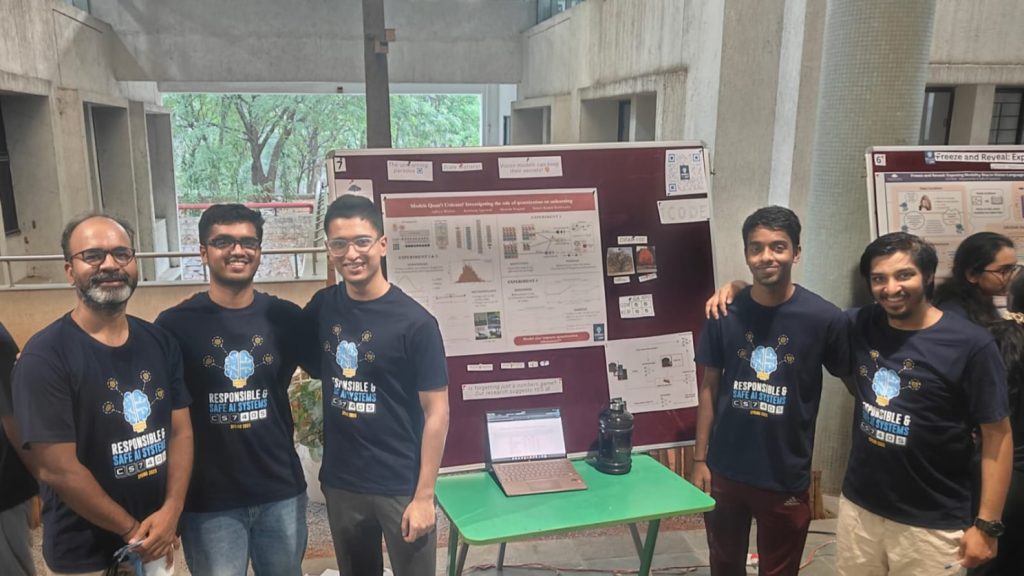
But wait! That’s not it. Most Precoggers explore multiple research directions at the same time to see what stands out for them the most. So, unsurprisingly enough, this was not the only project I was working on this entire time. I was also working on LLM Interpretability with my coauthors Sweta Jena and Shashwat Singh. Sparse Autoencoders were all the hype in Interp, and we were trying to question that paradigm. We had architectures in mind that could outdo these Sparse Autoencoders in tasks like steerability. We made consistent progress on this project throughout 2025, but finally we succumbed to the bottleneck of the availability of pretrained SAEs to experiment with. Since we did not have the compute to pretrain ourselves, there was no way out of this. However, we had developed many clever hacks, techniques and workarounds over this time to run experiments in this compute intensive domain with limited funding. In my eighth and final semester, it was finally time to accept it: this was not going anywhere further.
At the same time, it was time for me to pack my bags and go to Singapore. Why? To attend the Association for the Advancement of Artificial Intelligence (AAAI) 2026 Conference! I was on my way to meet some of the brightest research minds from all across the world. I got to meet researchers working in so many different niches. One fascinating direction of work I discovered here was researchers working in the intersection of music and technology, how AI is impacting music, music production, and other aspects of music – both as an art and also as an industry and business. I got to discuss with students working in this field about the future of where we are going, and so on. In the AI for Environmental Science Workshop, where I presented, I met researchers who had not just crafted novel ideas, but had deployed systems with an elegant touch of engineering, transforming the lives of people around them. These contributions included noise cancelling technologies for hospitals, schools and houses in busy areas near high-traffic roads; and earthquake and cyclone detection systems spread across entire countries to alert people. I saw impactful research all around me and it broadened my understanding of what research at scale can look like.
So this was my 2-year journey with Precog. I didn’t just get to learn about multiple research domains by working on my projects, but also all the other quirky and creative ideas my labmates were coming up with. (Some of these ideas went on to become impressive papers.) My growth here was not one-dimensional. Technical skills are not the only things one gains at Precog. The community is just as meaningful. I got to work and interact with interesting seniors, and most of us have stayed in touch even after they graduated. I must say the same for my juniors.
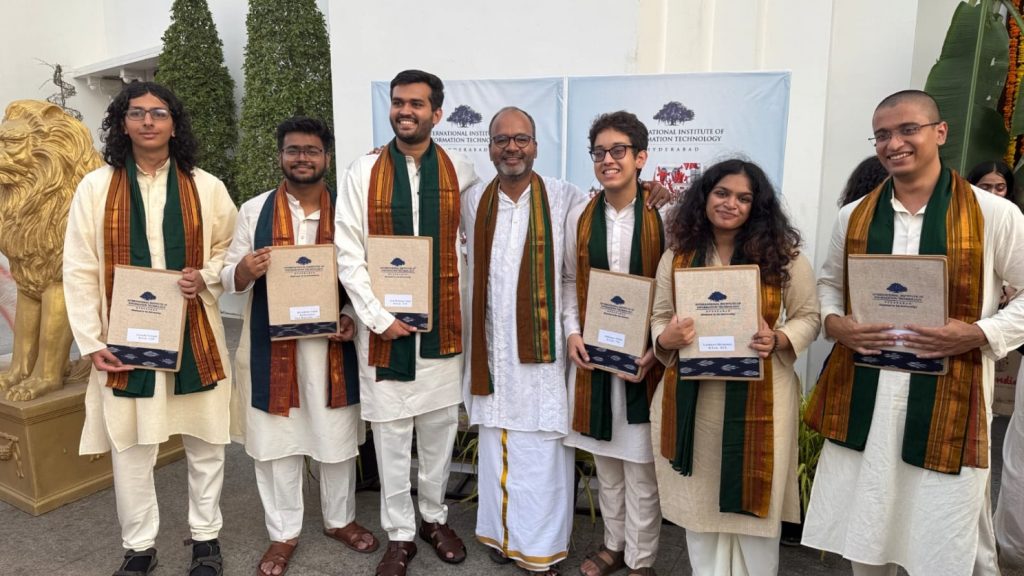
Tejas Cavale, Akshit Sinha, Sreeram Vennam, Ishwar Balappanawar, Karuna K Chandra, Sumit Kumar, Monish Singhal and Anish R Joishy were not just my Precog buddies, but I also valued their inputs for many career as well as life decisions. I am thankful for the network that Precog gave me access to, and we could all grow together in this journey, making each other better versions of ourselves. My work after Precog might be very different from the domains I worked in at the lab. But did Precog make me a more diligent worker? Yes, absolutely. Did it help me become a more confident presenter after two years of Wednesday weekly group meetings? Yes, absolutely. Did it teach me to stay persistent despite rejections? Yes, absolutely. Did it leave me better prepared for whatever comes next?